One of the things I truly enjoy dabbling in is comparing stories and situations of indigenous peoples of Europe and North America, especially curious in the shared similarities in animistic and polytheistic religious practices, and how both were treated in the name of Christianization. Yet, as I dig deeper, becoming aware of the history, I find it increasingly difficult to not sound like I’m “bashing”. I mean, the straight-up history is, quite frankly, brutal and cruel… and it has nothing to do with bias. Essentially, it reveals stories about suppressing indigenous/native forms of religion and “bettering”/”domesticating”/”civilizing” through Christianity. Further, I’ve found that, as some countries have attempted to a spirit of nationalism, there has actually been a resurgence of the “old practices” (indigenous forms of faith). I’ll discuss that at another time. Take all this as you will, as you venture into this post and others on this blog.
Before I go too much further, however, I find it necessary to discuss the use of the word “indigenous”. I think many, especially in North America, may be hung up on the stereotype of the word. Yet, to be clear… yes, even the main inhabitants (Pretanī) of the Iron Age British Isles were called “indigenous”, though descendants of Neolithic peoples were there first. So, the “indigenous” label is more encompassing than I think most realize… perhaps being tainted by the way in which many view Native Americans. I think there’s an argument to be made for “animistic and polytheistic practicing peoples being in one geographic area for a very long time” actually being “indigenous”. Perhaps, in fact, “indigenous” might be considered a slur, wrongfully judgemental of peoples who “need(ed) civilizing” and being brought up to speed with that which is “right”, especially in the way of religious conversion.
In that Sámi National Day just passed, on February 6, let’s take a quick look at them and their historic faith practices.
While most Sámi today belong to the state-run Lutheran churches of Norway, Sweden, and Finland, and some Sámi in Russia belong to the Russian Orthodox Church, indigenous Sámi religion (polytheism) has survived. Like many other indigenous faiths, Sámi beliefs are closely connected to the land, animism, and the supernatural. From Wikipedia:
… (Sámi) spirituality is often characterized by pantheism, a strong emphasis on the importance of personal spirituality and its interconnectivity with one’s own daily life, and a deep connection between the natural and spiritual “worlds”. Among other roles, the Noaidi, or Sámi shaman, enables ritual communication with the supernatural through the use of tools such as drums, Joik, Fadno, chants, sacred objects, and fly agaric. Some practices within the Sámi religion include natural sacred sites such as mountains, springs, land formations, Sieidi, as well as human-made ones such as petroglyphs and labyrinths.
Given the circumstances, it also shouldn’t be too difficult to understand how there’s evidence of synchritism, whereby Sámi beliefs incorporated elements of Norse mythology. Another topic for another time.
I don’t want to sound like I’m hurrying through and reducing an understanding of things to a few sentences. There is so much more worth reading, and I encourage it. Perhaps then, consider how contact with the spread of Christianity impacted the Sámi.
Christianity first arrived as early as the 13th century via Roman Catholic missionaries. Over time, the Protestant Reformation also came into play. Not only was the suppression of indigenous faith evident in the burning of rune drums, but adherents to traditional faith were branded “witches”. Again, from Wikipedia:
In this period, many Sámi practiced their traditional religion at home, while going to church on Sunday. Since the Sámi were considered to possess “witchcraft” powers, they were often accused of sorcery during the 17th century and were the subjects of witchcraft trials and burnings.
On into the 18th century, the pressure on the Sámi continued…
… Thomas von Westen, the “Apostle of the Sámi”, (who) burned drums, burned sacred objects, and converted people… Sacred sites were destroyed, such as sieidi (stones in natural or human-built formations), álda and sáivu (sacred hills), springs, caves and other natural formations where offerings were made.
As I mentioned, even I can’t help but think about the same situation in North America (and various stories of peoples throughout the world). Taking this further, I’m curious how so many have become detached from… though I’d dare say, many wouldn’t dare consider it… being descended from people who were rooted in these “pagan” beliefs. How is it even possible to be judgemental of people, in modern times, who turn to forms of “paganism,” especially when they do so in an effort to reconnect… not only with the faiths of their ancestors, but with nature… and that by doing so, they do it in the spirit of making themselves and the planet on which we live better.
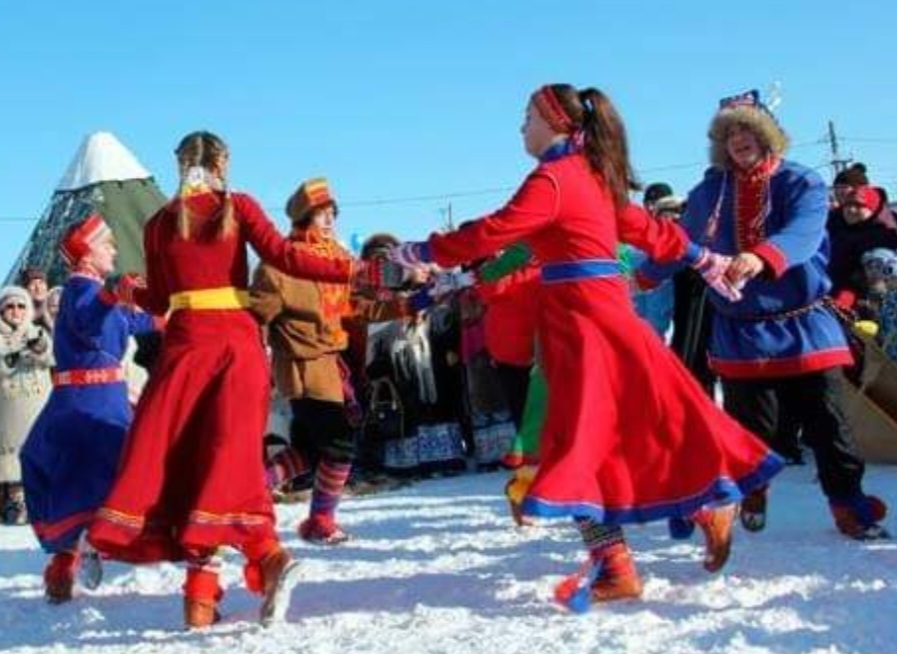
*Image of Sámi dancing.
 The Wild Pretanī