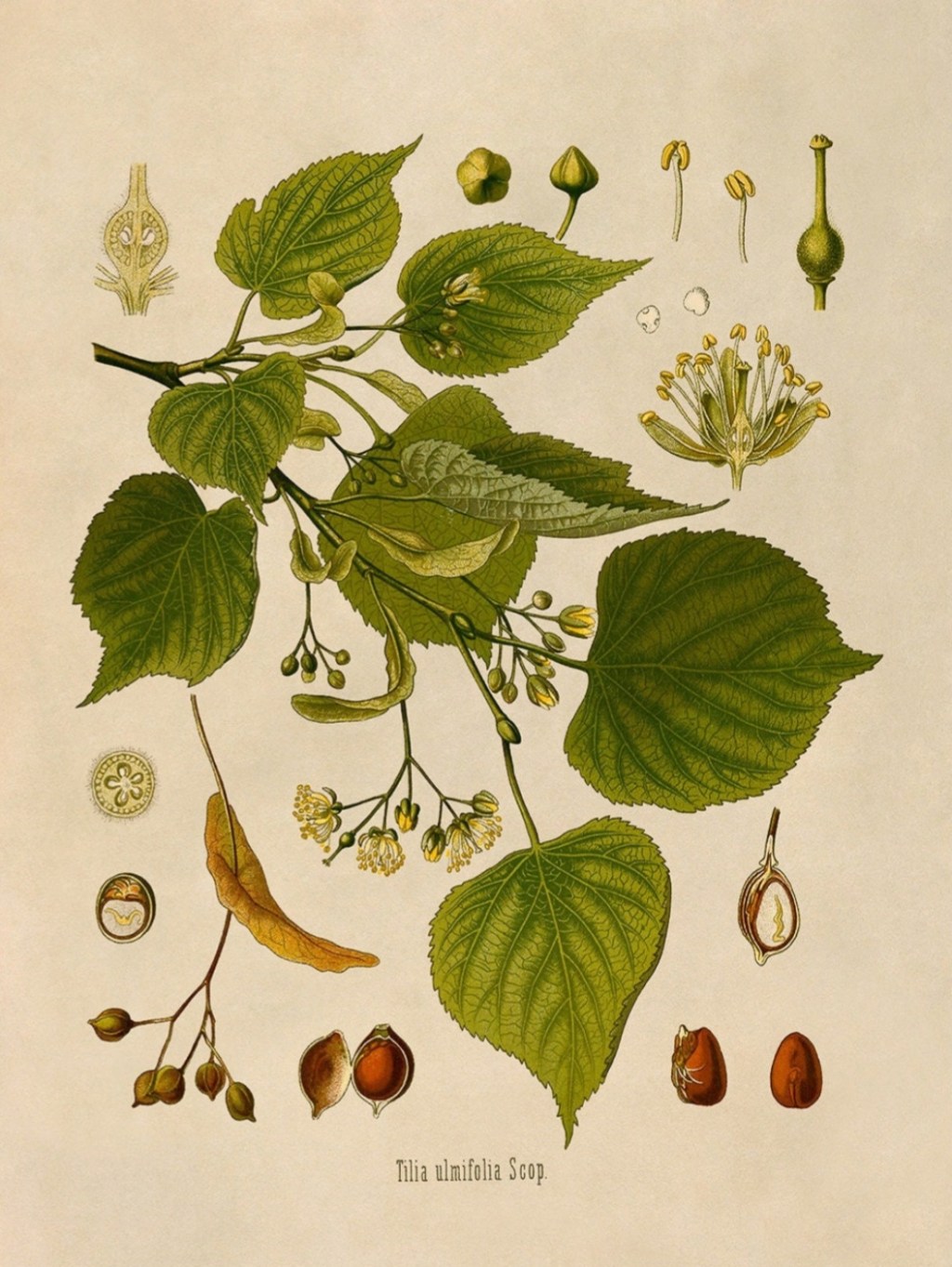
The linden tree. It stood unchanged since the first time Papa Horatio had seen it, all those years ago— unchanged, Alaine thought, for perhaps centuries. Always green, always blooming, even in the middle of winter. Now, at the cresting of summer, it almost blended into the deep green of the forest, except for the perfect circle of velvet green surrounding it. That, and the scent. Ebbing like a tide on the gentle breeze that stirred the linden’s leaves, the perfume mingled the ordinary golden florals of linden blooms with strange notes of vanilla and cedar and incense.” ~ Rowenna Miller, The Fairy Bargains of Prospect Hill
The Lime/Linden tree (genus Tilia) has a place among the “sacred” tree types of Europe. You’ll find it referenced in Slavic, Baltic, Germanic, and Greek mythologies… and even into Asia, in northern China. It also remains a national symbol of the Czech Republic, Slovakia, Slovenia, and of the Sorbs in Lusatia. Yet, when it comes to the Brythonic/Brittonic languages, words seem to struggle to find shared meaning and significance. Was that a reflection of lesser appreciation or respect?
At first, I thought… perhaps… but then, maybe I shouldn’t be so hasty.
In Welsh, breaking down the compound word, pisgwydden (plural: pisgwydd)… the first part, pisg, isn’t well-documented, and by itself, can mean blisters or pods. Yet, when combined with gwydden (gwŷdd, meaning “trees” or “wood”… by the way, that double “dd” should actually roll off the tongue as a “th” sound), it refers to the Linden tree.
The Cornish word (pry, prye, or prys), however, does not align (at least in my opinion) so smoothly in sound against the Welsh pisg, and I struggle to see shared origins in a Common Brythonic word.
That being said, I also saw a reference to the Cornish word Elowen (relating to Elaw/Elow) being associated with the Linden… though it actually means “Elm tree”. In this instance, the similarly sounding Breton word for the Linden is… evlec’h (or *evlec‘).
So, what’s going on?
At this point, I found it might be worth “climbing” from Brittonic, further up into the Insular Celtic linguistic tree, and then back down the other side, to Goidelic (Scots Gaelic, Irish Gaelic, etc.).
In doing so, I found the Gaelic word for linden tree (or lime tree) is crann-teile (Scottish Gaelic) or teile (Irish Gaelic)… both, clearly connecting to the genus name Tilia. The crann (tree) or craobh, means tree… and relates to the Gaelic leamhán (which, I would argue, sounds much like the Cornish elow/elaw).
I had to wonder if… in elow/elaw and leamhán, was I seeing something significant tied to the Old Germanic word for law (hinting at a possible connection in the Proto-Indo-European linguistic tree). After all, the Linden tree was symbolic for peace and justice (as well as… love, fertility, friendship, healing, protection, endurance, and renewal). Lindens were traditionally seen as a sacred space where no lies could be told. It was the site for assemblies, legal proceedings, and important judgments. Not to mention… the word law comes from the Old English lagu, which was borrowed from the Old Norse lagu, meaning “things laid down or fixed,” derived from lag (“layer, measure”), ultimately from a Proto-Germanic root related to “to lie” or “to lay”. This highlights law as something established or set, unlike Latin-derived terms like lex or legal, which come from roots meaning “to gather” or “to bind,” showing different cultural approaches to defining law (laid down vs. gathered rules).
Yet, as I kept unraveling, it seemed more likely that I had encountered a homophone… the whole “sounds like.. but isn’t the same”.
Looking just at the Gaelic leamhán, I found it could mean a number of things… from elm tree, to a moth (particularly a clothes moth), and even to the marshmallow plant… which shares linguistic roots related to softness or weakness.
Wait, wait… softness or weakness?
Without going too far down yet another path, it’s probably worth noting that the Linden tree is soft and easy to carve, making it suitable for instruments, furniture, and sculptures.
It seems the further I go, the more uncertainties and/or possibilities there are.
Back to my original question, then…
Was the Linden tree of lesser importance to Britons? More specifically, I wonder if it was less significant to Britons, say… prior to the arrival (ca. 410 AD/CE) of the Anglo-Saxons, who… perhaps… brought with them the significance of Germanic symbolism of the Linden?
I can’t find a definitive answer, and given the timeline and scant history, it really shouldn’t surprise me.
Coming down the historical timeline, the Linden seems to have held some significance in Britain. J.R.R. Tolkien’s Lord of the Rings certainly left us tastes of its enchantment in both Aragon’s Song of Lúthien…
He heard there often the flying sound/Of feet as light as linden-leaves.
… and Legolas Song of Nimrodel…
And in the wind she went a light/As leaf of linden tree.
… both, seemingly, influenced by Geoffrey Chaucer’s (ca. 1343-1400) Canterbury Tales…
Be ay of chiere as light as leef on lynde,
And lat hym care, and wepe, and wrynge, and waille!”*
I’m curious, though. Even with the boost from Tolkien, how did the Linden get left out in the contemporary sacred Pagan trees of the Wheel of the Year?
So ends today’s journey in the Brittonic…
*Be ever of cheer as light as a leaf on a linden tree,
And let him (your husband) care, and weep, and wring his hands, and wail!”)
 The Wild Pretanī