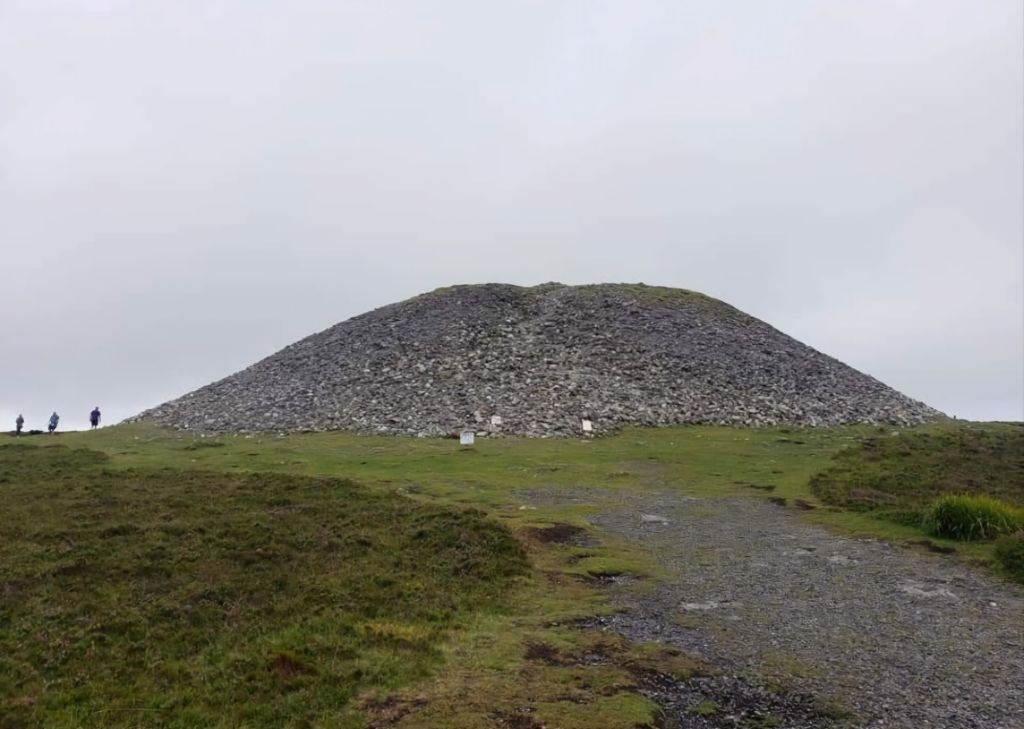
Late in July 2021, on my second trip to Ireland, I headed to the northwest to see “Queen Maeve’s Cairn”, Ben Bulbin, and a number of other sites in that area. Already moved by the sites I had taken in two years (including Rathcrogan and Brú na Bóinne) before in Ireland, sometime on the ascent to “Maeve’s Cairn”, there was a personal “hard-stop” moment. Looking over to my daughter, I asked aloud… more or less… why “we” (people of European descent) surrendered this sort of spiritual heritage, connected with our own ancestry, for Christianity. It proved to be a key point in reassessing my thinking.
Now, “Maeve’s Cairn” (a Neolithic burial mound on Knocknarea/Cnoc na Riabh, in Sligo) is believed to date to around 3000 BCE (perhaps even older… 3500 BCE), and the legend of Maeve (if she actually existed) places her life at around 50 BCE to 50 AD… so, “Maeve’s Cairn” could not actually be, literally, her burial spot. But, I digress from the point.
The larger realization is that, at around 3500 BCE, the cairn is as old as… if not older… than the pyramids of Giza. Since then, I’ve been to other ancient sites in Europe (and plan to visit more), including (just this year) very similar cairns in Tanum, Sweden. I’ve also expanded my readings to understand more about the history of animistic and totemic practices… paralleling others throughout the world, including those practiced among Indigenous Peoples of North America. I’ve also delved deeply into efforts by contemporary people to reconnect with that form of spirituality… sometimes more conjecture than history, and sometimes actually well-grounded in history… but that’s another discussion in itself. It seems off-putting, then, to see how Christianity pushed aside Europe’s true connections with that spirituality for another faith that evolved nearly 6,000 miles away (distance from Knocknarea to Jerusalem) in an entirely different culture. Further, ignore it as you may, that “push” was anything but peaceful… and it was most certainly done with anything but good, “wholesome” intentions.
One doesn’t need to look far in regard to the expansion of Christianity in Europe to see how brutal it was (when the expansion was actually recorded). From stories about the British Isles beginning in the 4th century, Charlemagne’s massacre of pagans at Verden in October 782, to the brutal crusade against pagans in the Baltic region through the 13th century (look-up the Northern Crusades), one would think, in retrospect, modern Christianity would be more humble in its approach to other beliefs. Some Christians actually are humble… but given the “bullying” actions of others, from the condemnation of attempts to reconnect to old traditions such as Beltane and Samhain, to the efforts to force the bible on school children in public schools in Oklahoma and the display of the ten commandments in Louisiana (and these instances are but a few of what continues)… Christianity is anything but comfortable without continued expansion.
Reading about all of this only serves to increase understanding of the larger picture. Consider then why there is any “forbidden fruit”… especially from a “tree of knowledge.” If partaking means expanding one’s intellectual self and growing even more spiritually… eat on. Surely, the powers that be would prefer we continue to evolve, and only those who want to suppress and control would prefer otherwise.
“Forsake not,” then, our own origins and the historical and spiritual lessons we can find in the stories of our ancestors…
 The Wild Pretanī